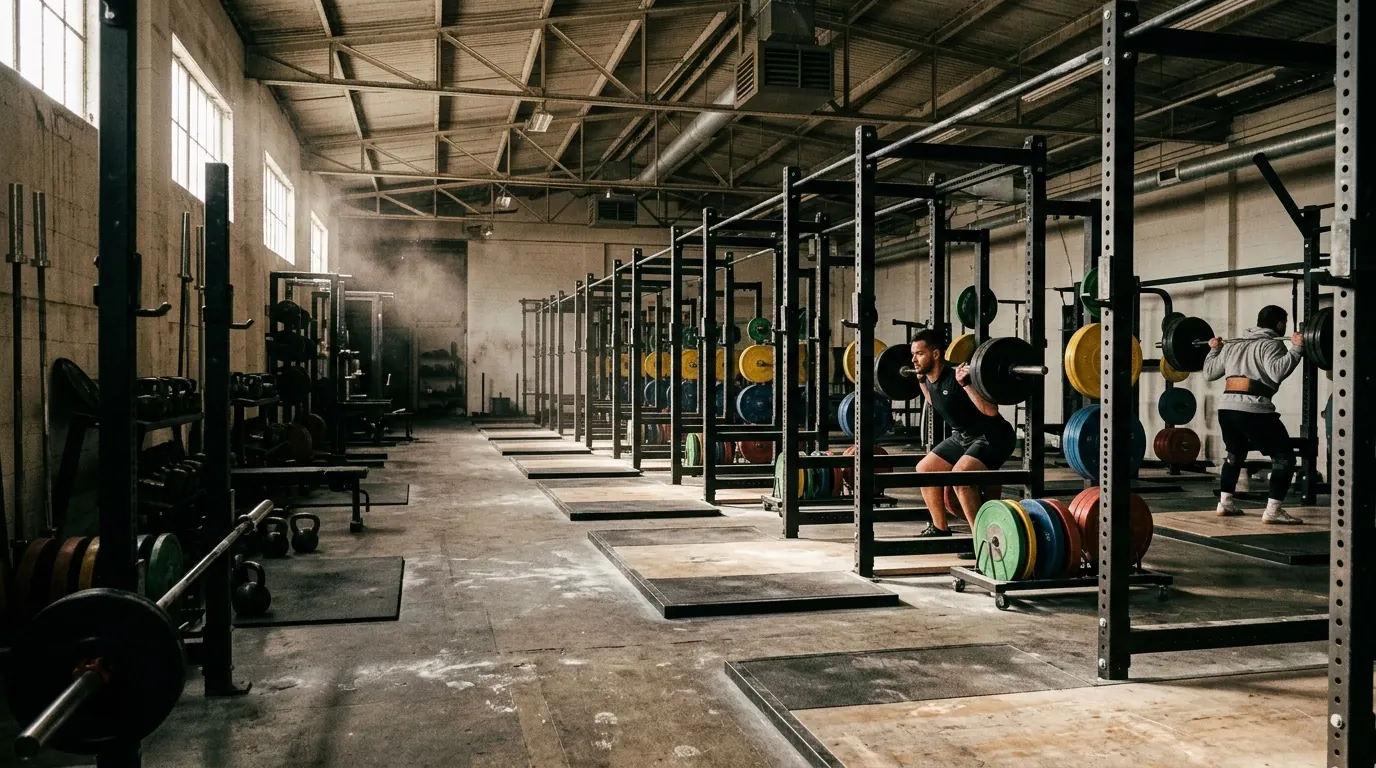
06:12 Monday Week 3 of 8
The Lifts. The Conditioning. One Plan.
Four days of lifting, two of conditioning. For years that took Strong for the sets, a timer app for the intervals, and a spreadsheet to guess whether one was eating the other. Now one plan sets both, down to the effort of every set.

Check: the planCheck: the clockCheck: the liftCheck: the week
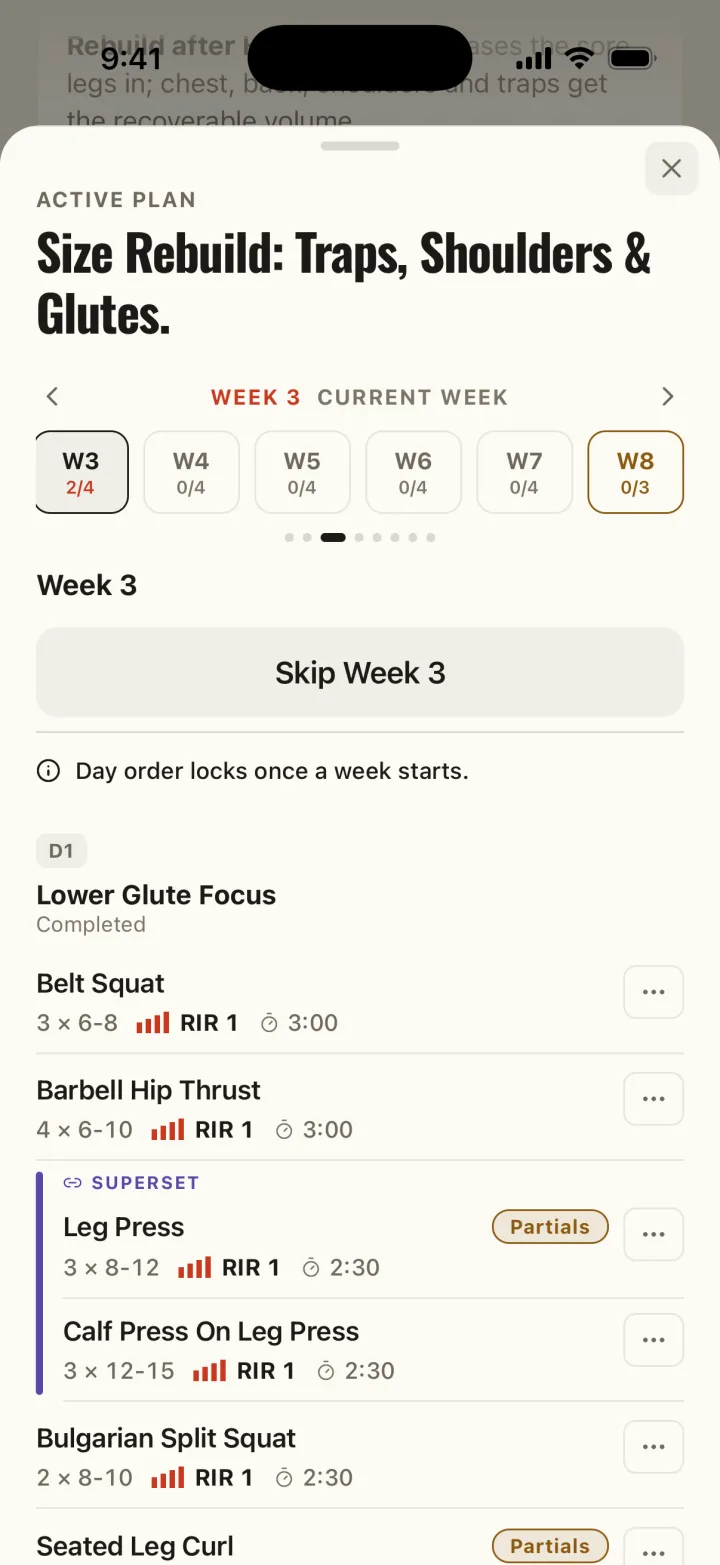

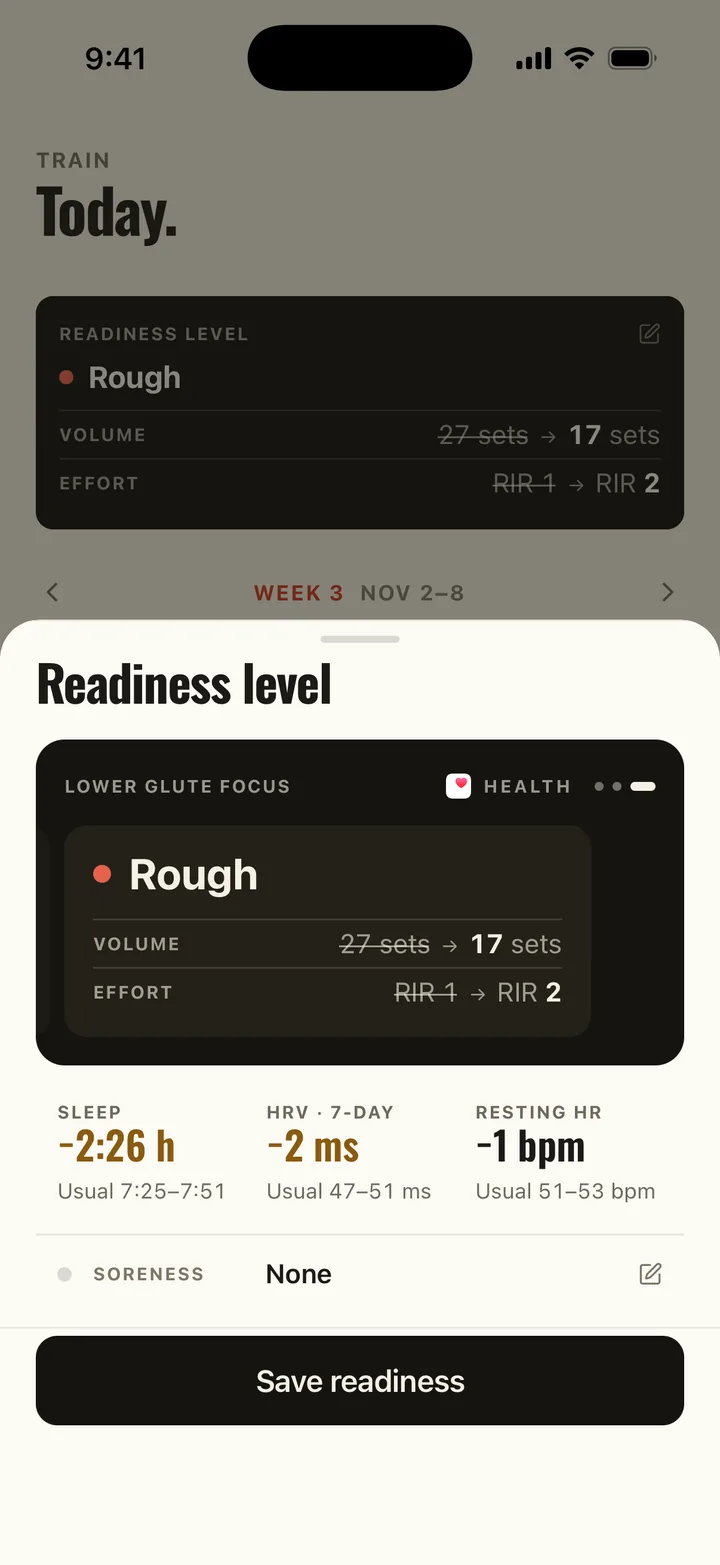
Rough night. Ten fewer sets.
Before I touch a bar, one tap on how I feel. Sleep and HRV are already in from Apple Health. Today reads Rough, so 27 sets become 17 and every set stops a rep earlier. I train what I can recover from.
Check: readiness
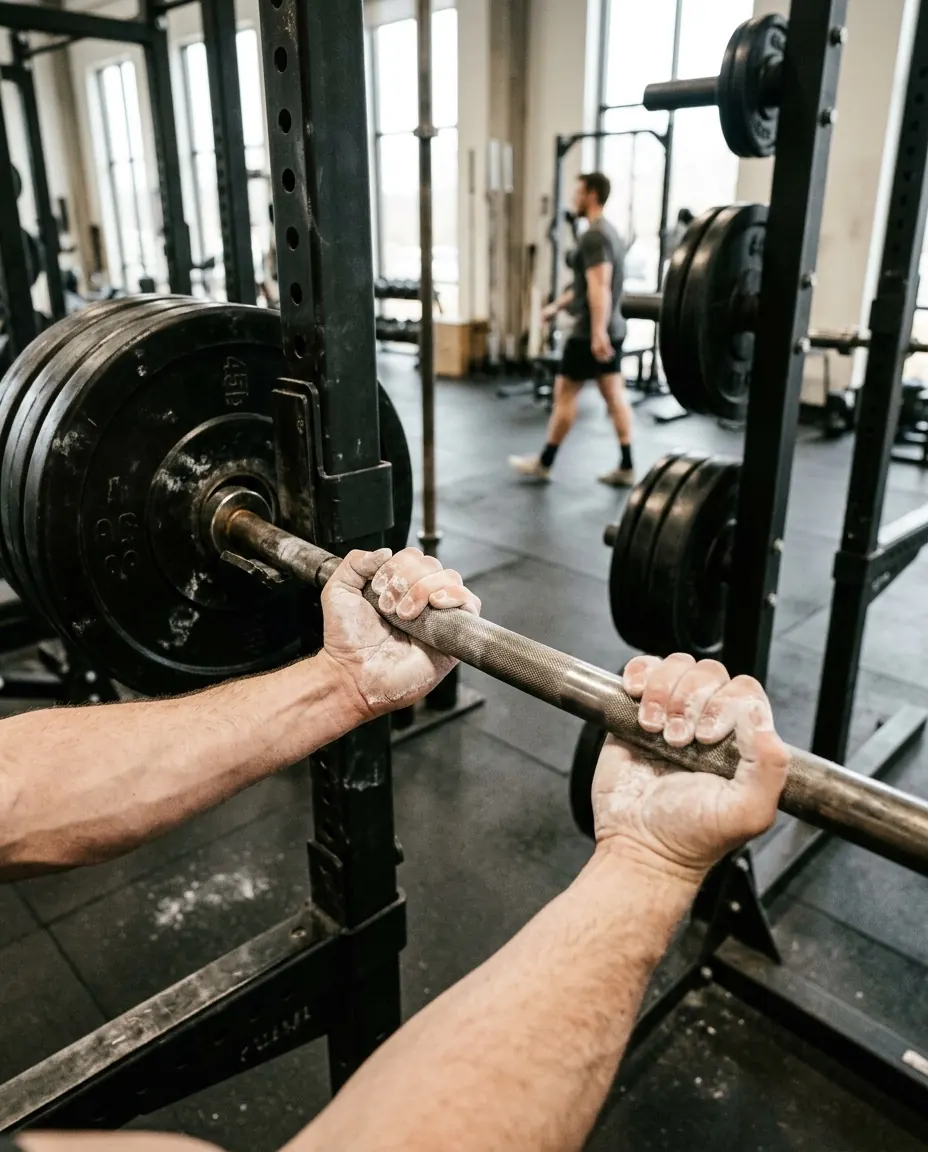
06:24 Barbell squat 5 × 5
Tap the set. Rest starts.
Last time's numbers sit beside each set, with the weight already in. I tap the set when I rack the bar, and the rest timer runs.
The EMOM is the next card.
The conditioning used to live in a timer app that forgot it when the beep stopped. Here it sits under the squats, in the same session.
Check: the session
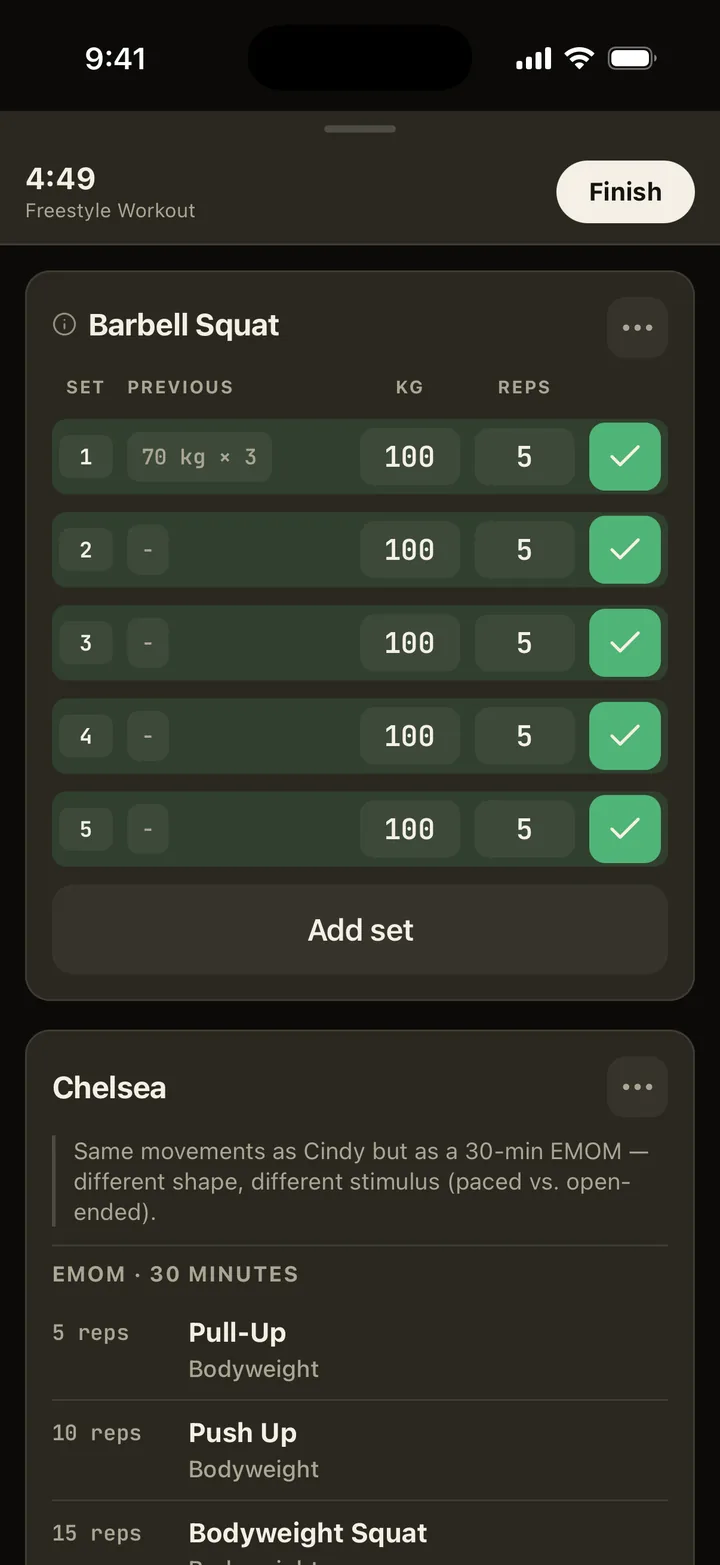
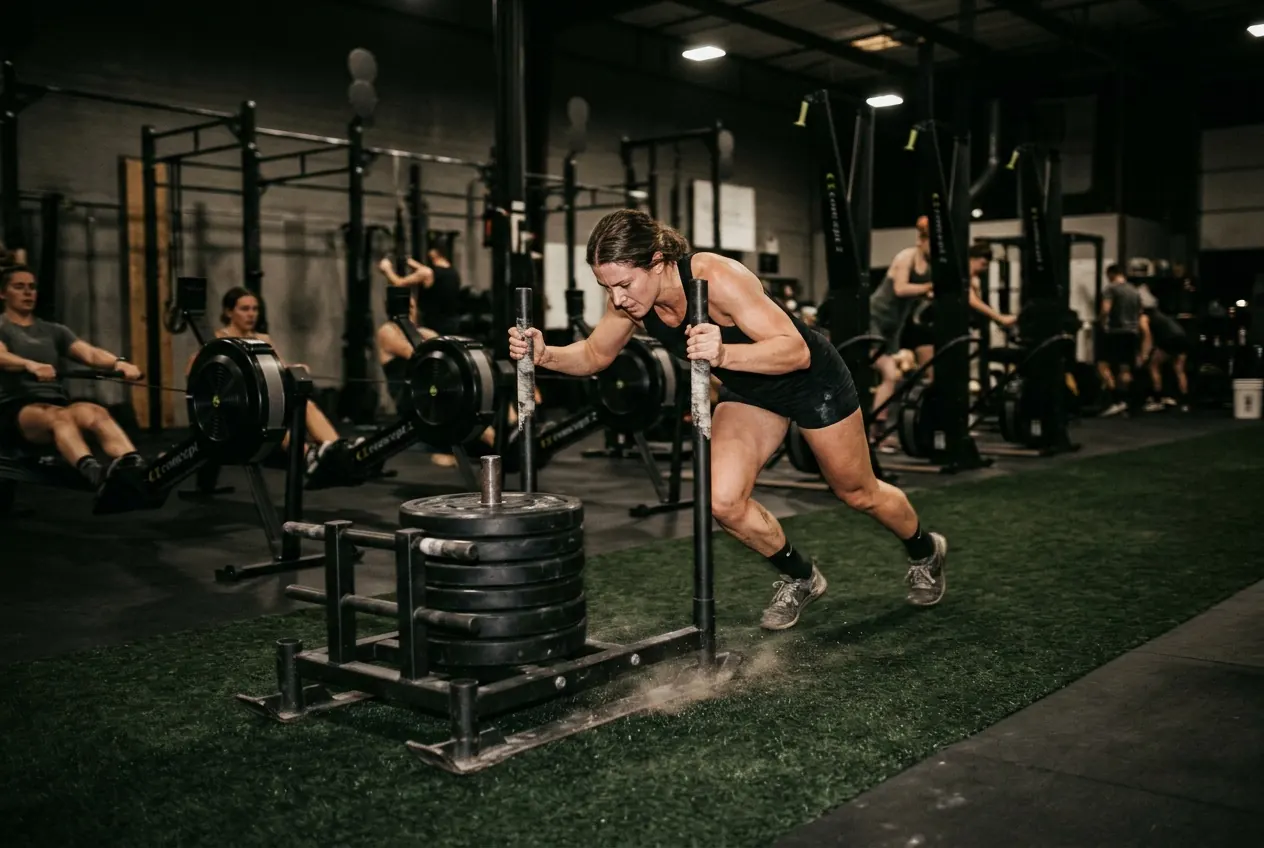
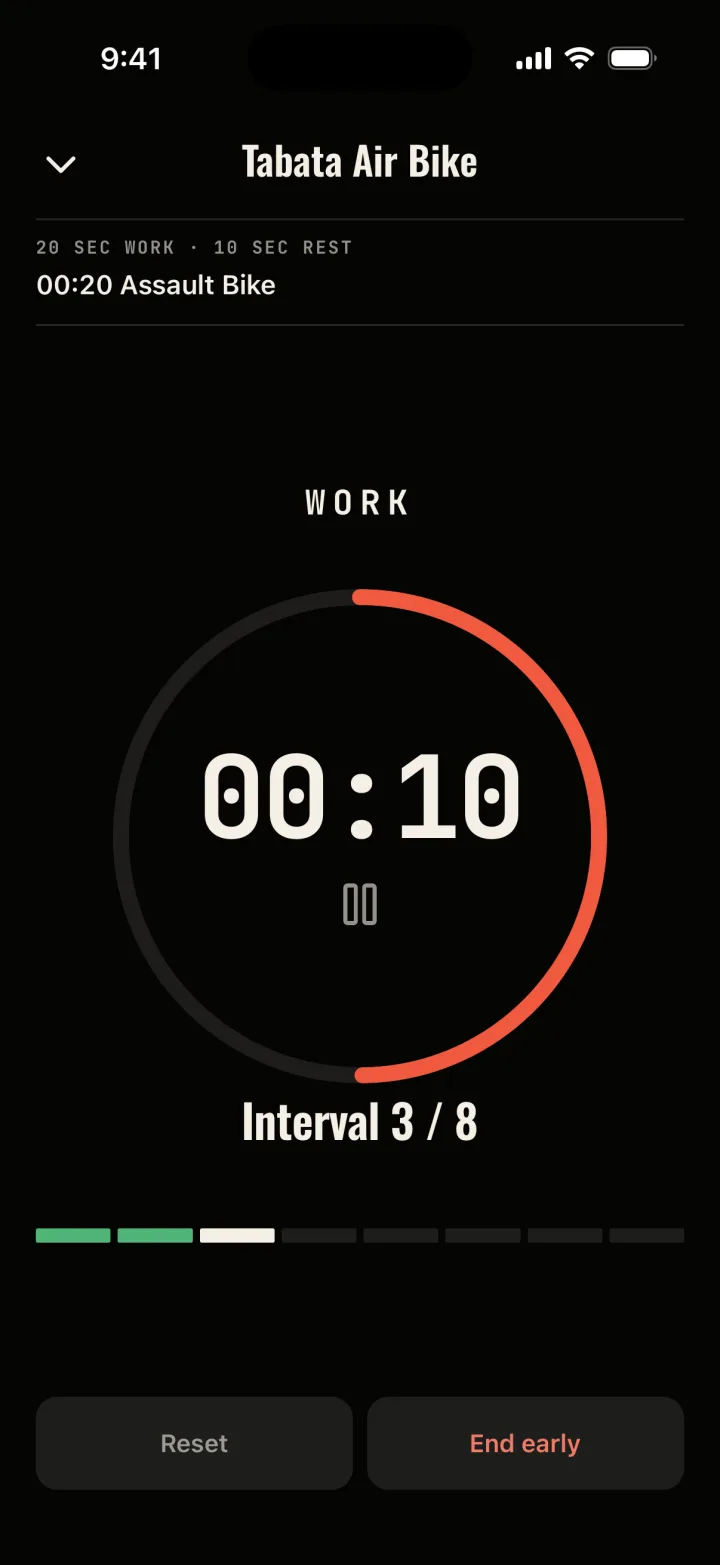
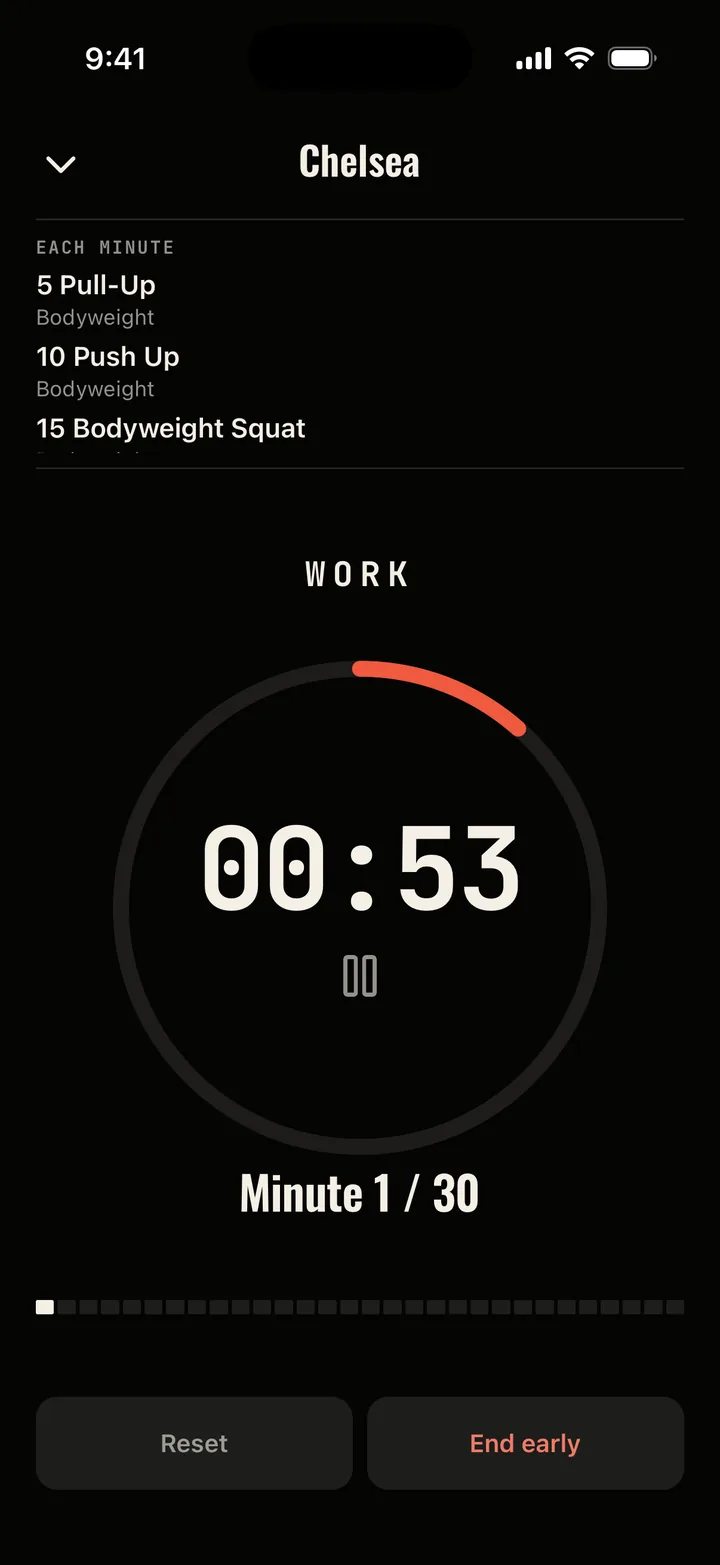
07:02 Chelsea EMOM · 30 minutes
Every minute, for thirty minutes.
Five pull-ups, ten push-ups, fifteen squats, then rest until the minute turns. The app calls each minute, so I count reps, not seconds.
The rounds land in the record.
Thirty minutes later, the rounds sit in the same workout as the squats. Next week's plan counts both, so the conditioning never quietly eats the lifting.
Check: the clock
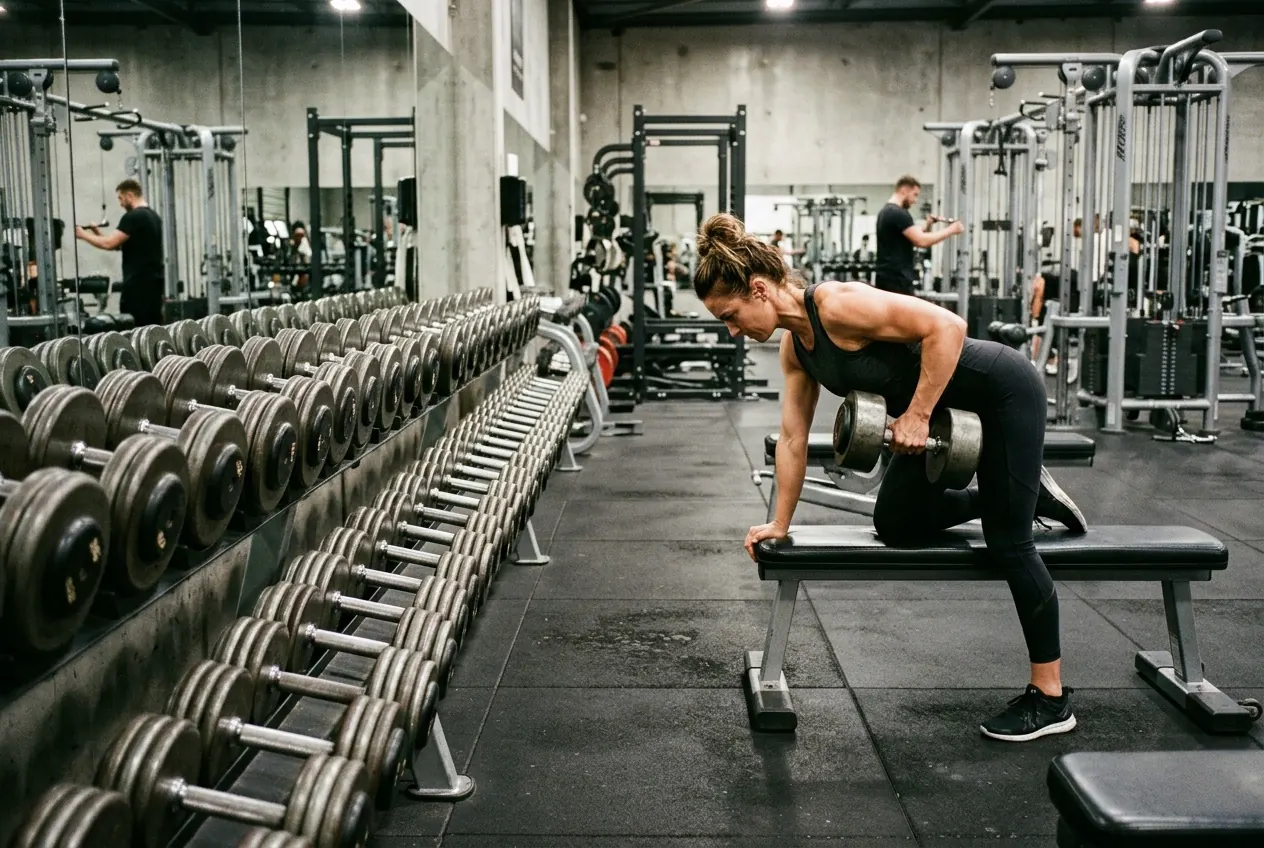
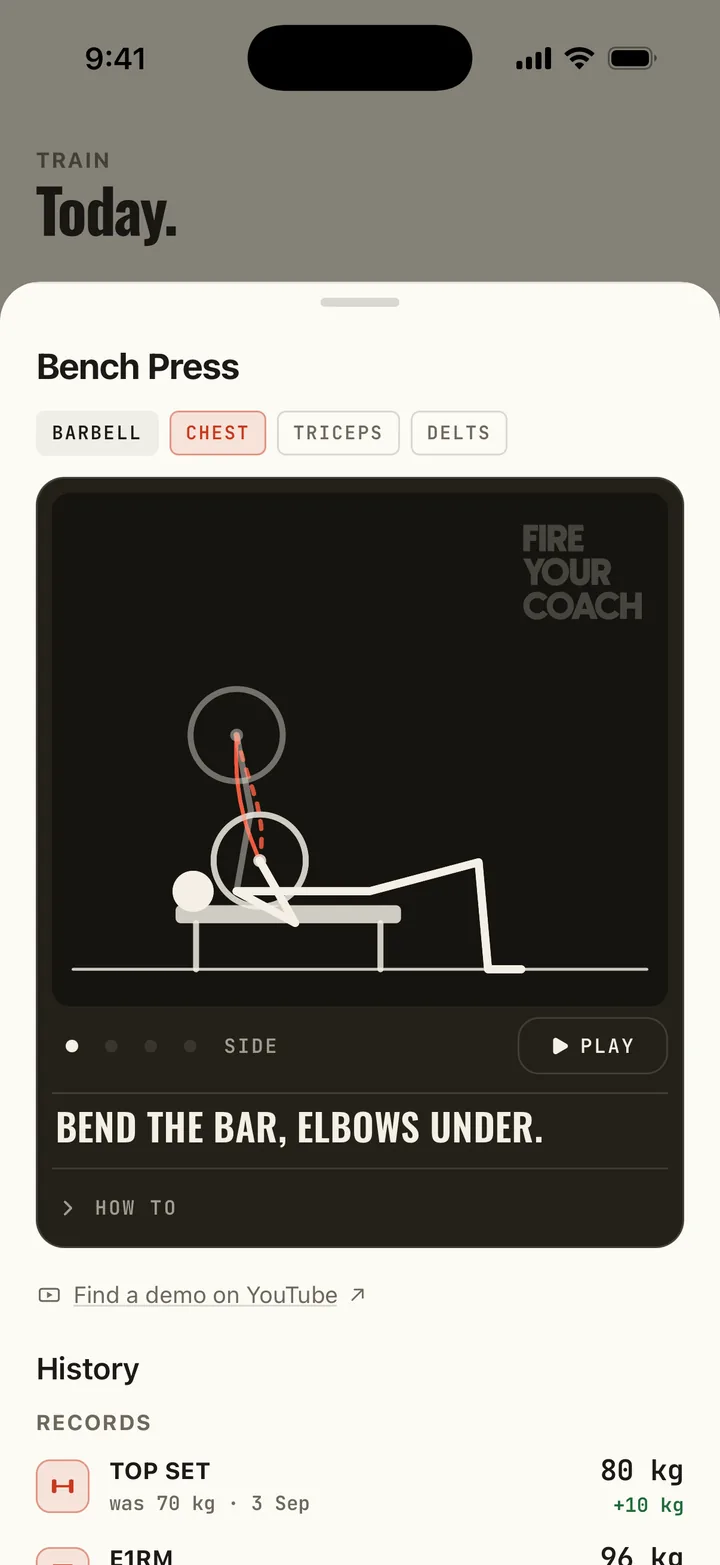
Thu 06:40 Bench press 4 × 5–7
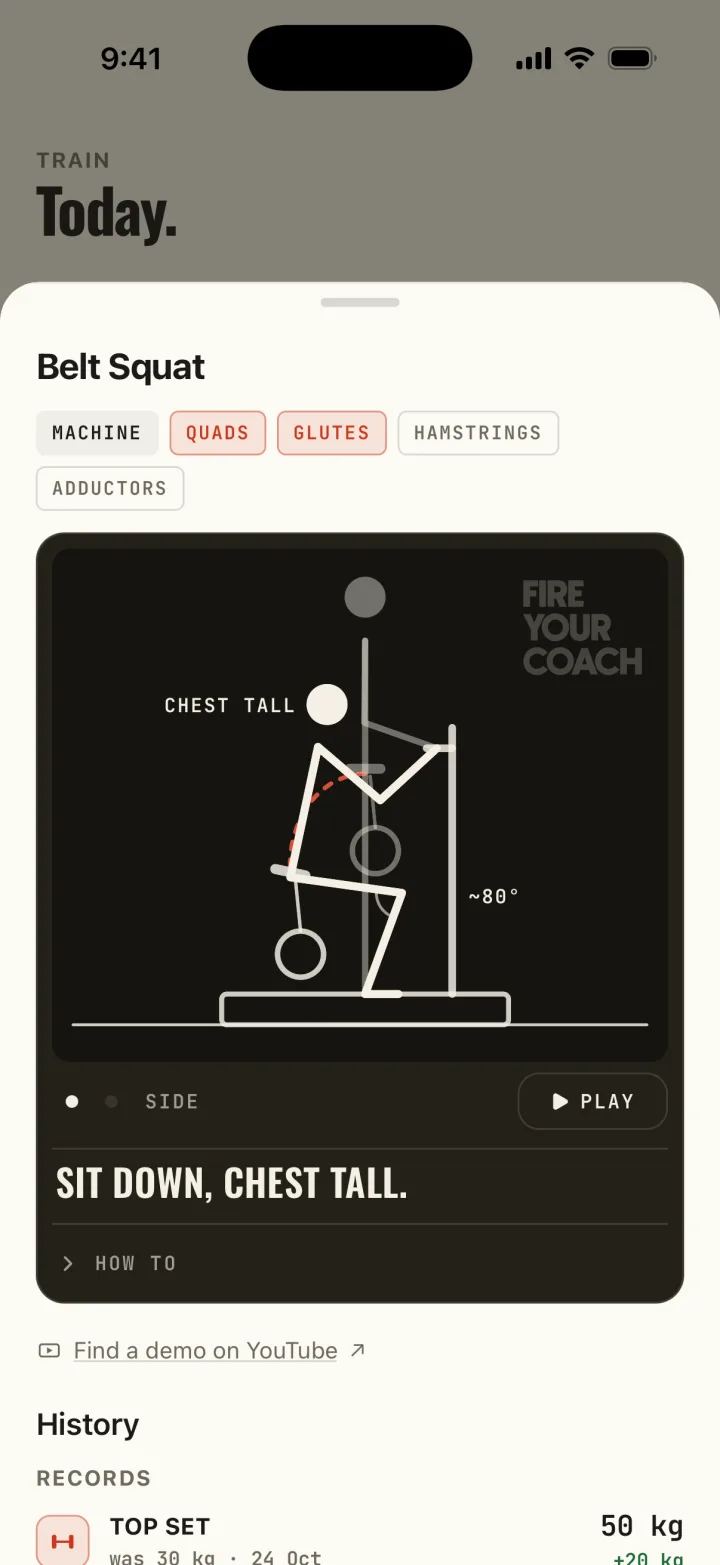
One look before the first set.
The card shows the lift, drawn, and the one cue that matters. Bend the bar, elbows under.
The records sit under it.
My top set went from 70 to 80 in September. I know what the bar should feel like before I lie down.
Check: the cue
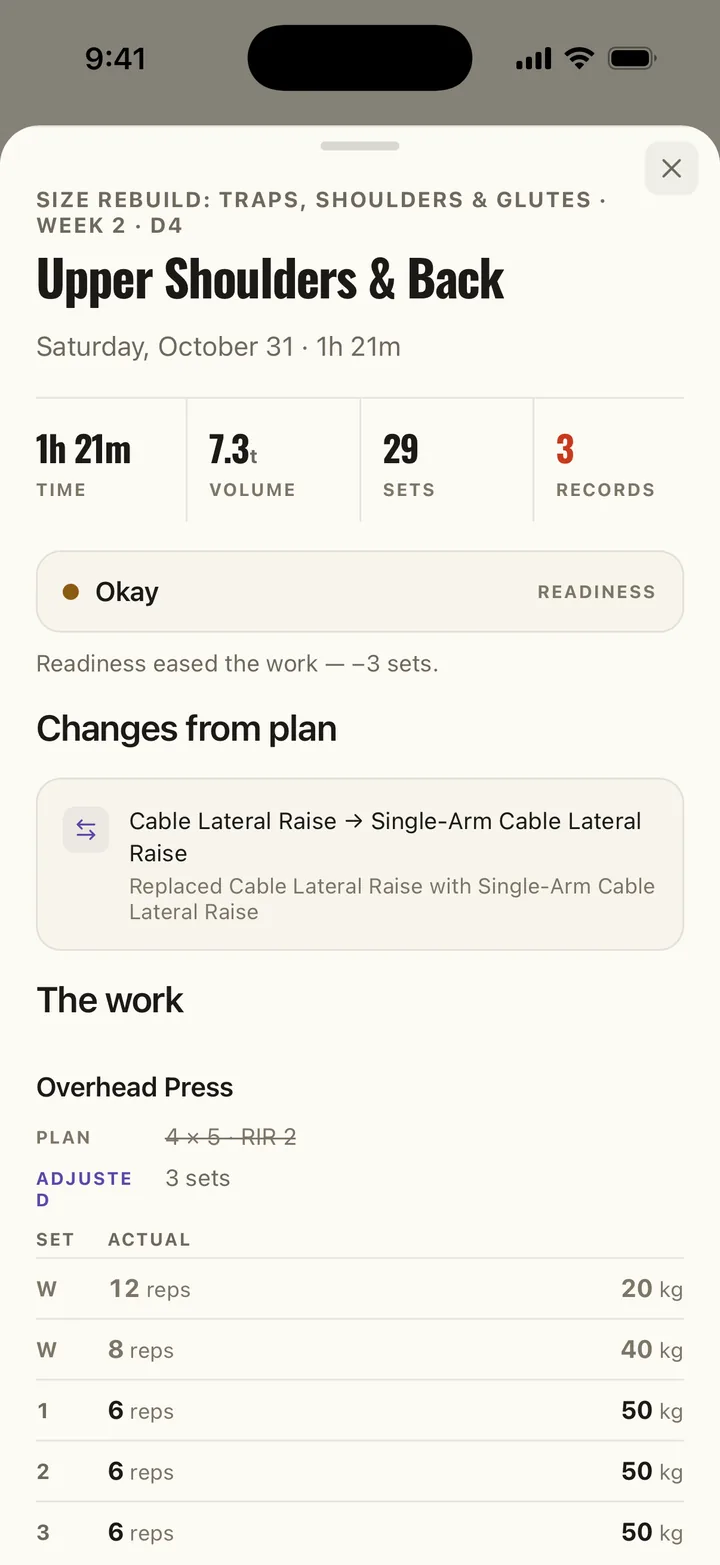
Sat 08:11 Done Saved
I leave. The record stays.
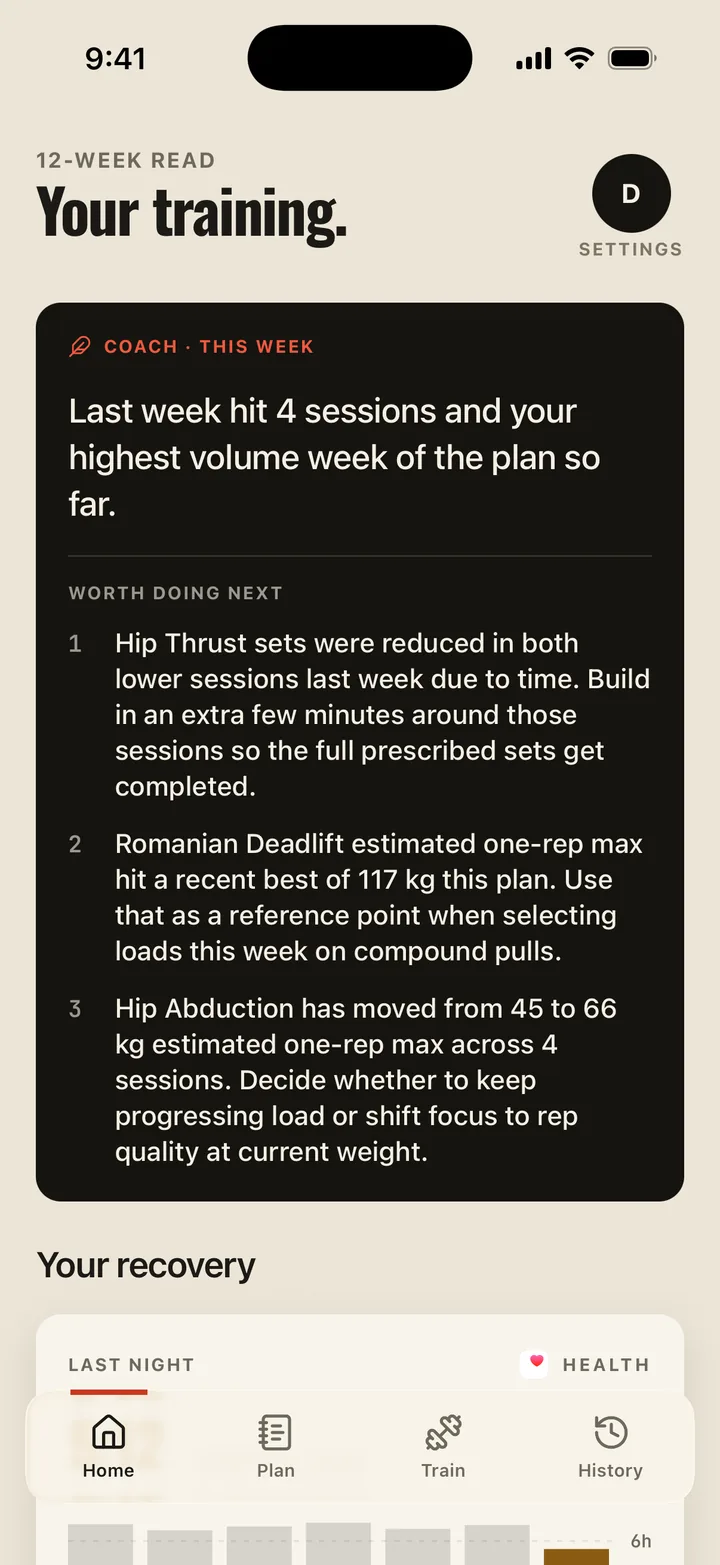
Readiness took three sets off. I swapped the cable lateral raise for the single-arm one. Three records. All of it is kept beside what was planned, so next week starts from what happened.
Check: the recap
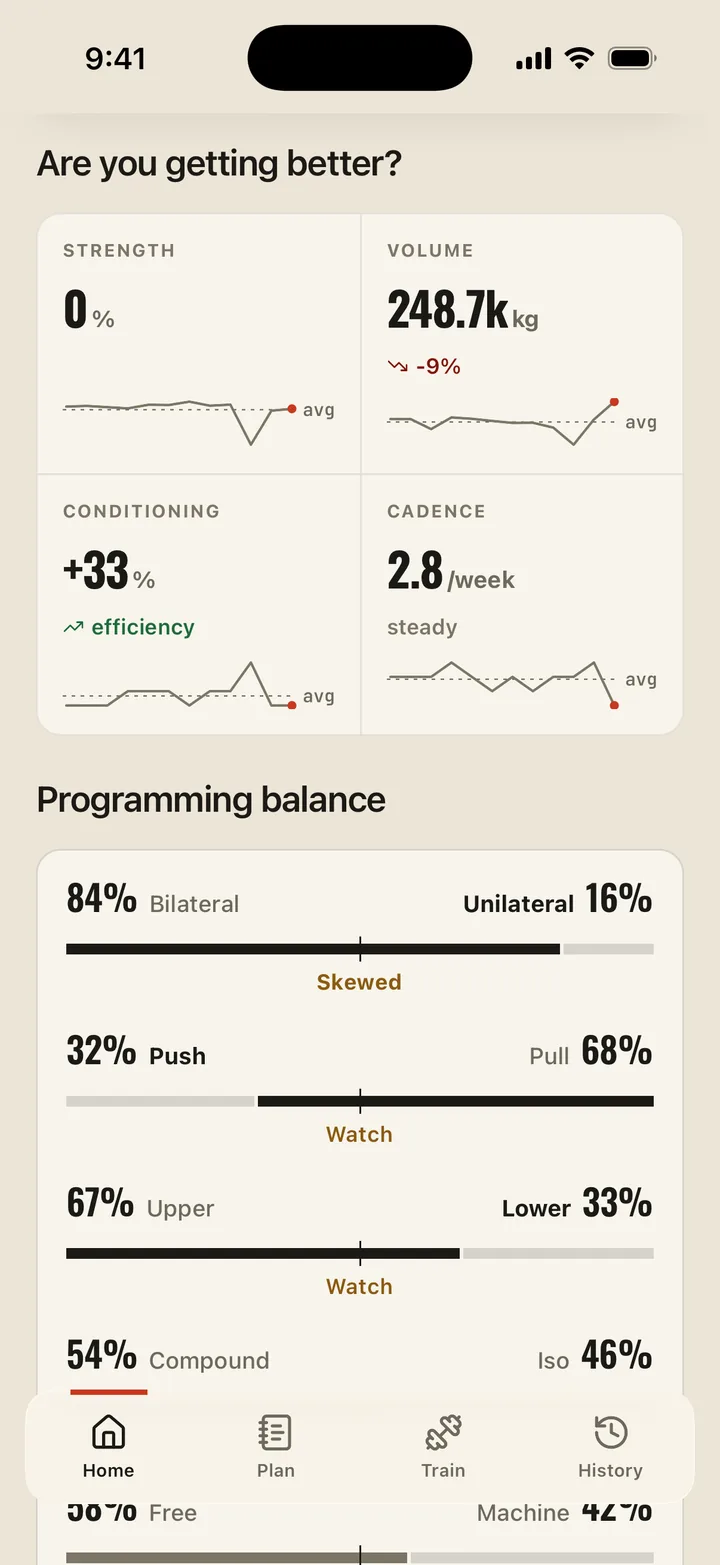
Sunday. Am I getting better?
Strength, volume and conditioning against my own average. Conditioning is up 33%. Strength is flat, and that's the next program's job.
Check: the trend
Every set prescribed. Not just logged.
A tracker writes down what you did. This tells you what to do today: how much, how hard, and when to back off.
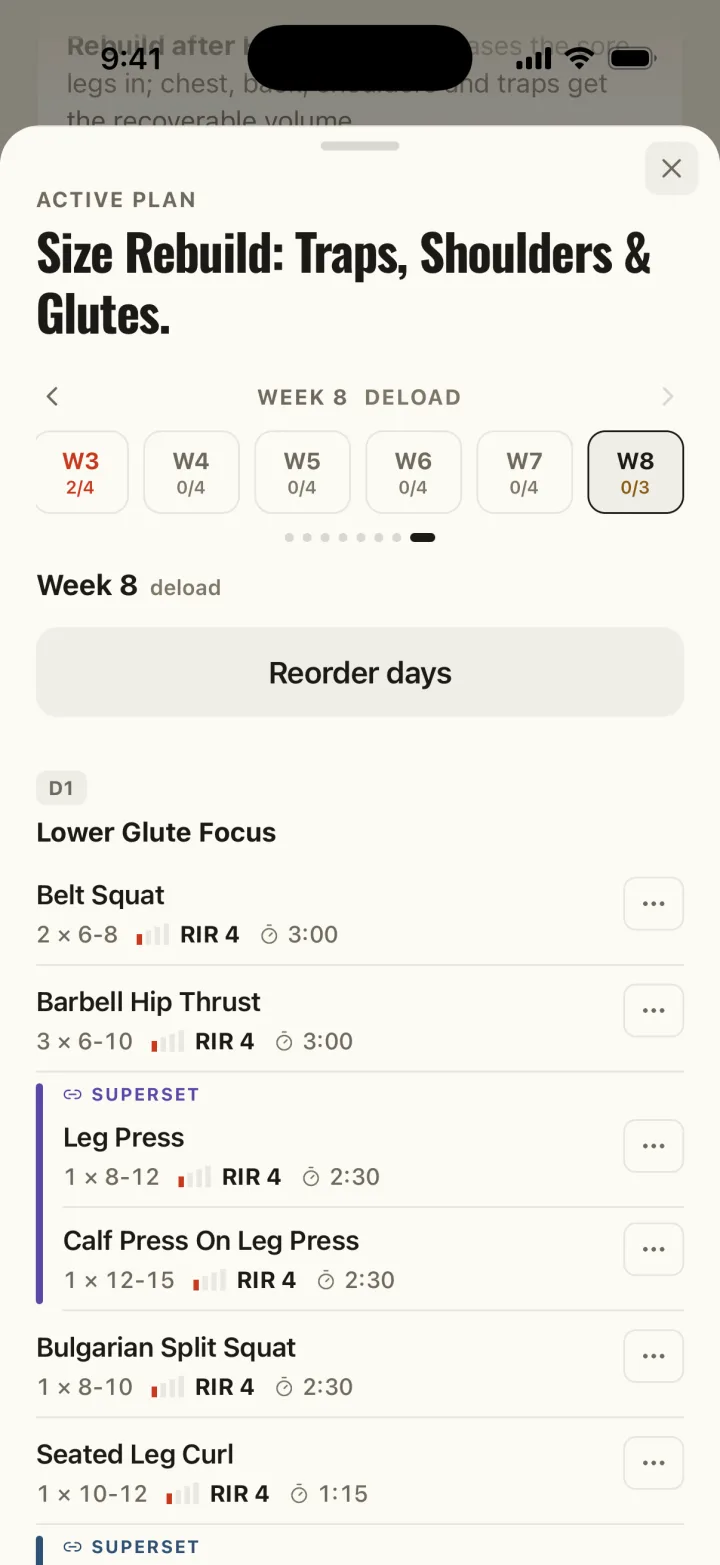
Effort, prescribedEvery set has its reps and its reps in reserve. The deload week is written in before you need it.
The clock runs itselfEMOM, Tabata, AMRAP and intervals, full screen. It calls every round, so you count reps, not seconds.
Every lift, drawnA figure of the movement and the one cue that matters, one tap away between sets.
The week, read for youEach week, a note on what moved, what stalled and what changes next.
Your health data in. Your record out.
It reads what your phone already knows. Soon your AI assistant can read what the app knows.
Last night, before the first set.
Connect Apple Health and last night's sleep, HRV and resting heart rate fill in the readiness answer each morning. You can change it; the answer is yours. Each finished workout is saved to Apple Health, and Whoop and Oura come in through it. More sources are on the way.

"I never knew if my lifting and my sport were fighting each other."
I'm David, 37. I've lifted since I was 16 and played football my whole life. Add 7+ years of CrossFit and 4 Hyrox races, the last on 17 October, off a plan this app wrote. I was never going to pick between the gym and the sport. But too much of one, and the other paid for it: I overtrained, ran on empty, and got hurt. I'm a nerd for this stuff: thousands of hours of Dr. Mike, Jeff Nippard, Athlean-X and others.
After years of paid coaching, I learned to write my own programs. But it took forever: digging up old plans, reading my trends, pasting it all into ChatGPT, catching its mistakes. On a good run, that was a week of calibrating and tweaking. And how hard to go was never clear, least of all after a bad night's sleep, with my fitness band screaming “take it easy today.” About 600 of my sessions sit in Strong. My years of CrossFit sit nowhere, and so do my first three Hyrox preps.
So this app does that part. It writes one plan for your lifting, conditioning and cardio, and prescribes the effort and intensity of every set and interval, so one never eats into the other. After a bad night, it cuts the day back. Now it's free on the App Store.
Roster & cuts.
Built for you if
- You lift three or four days a week and do conditioning on purpose
- You write your own programs, or want one written in a method you trust
- You run your training out of Strong, a timer app and a spreadsheet
- You play a sport or race, and you want the lifting to help it, not fight it
Not for you if
- Beginners. If you don't know what RIR means, this isn't for you yet.
- Want the app to decide for you. You make the calls. It keeps the record.
- Just want a set logger. Strong is better at that alone. This is for the lifter whose week does not fit in it.
- Program hoppers. This gets better the longer you commit to one plan.
Questions from the locker room.
It tracks, and it tracks the conditioning too. Sets, weights and reps like Strong, plus the EMOM, the intervals and the carries as rows in the same session, with the timer in the app. Train opens on today's session. Home is the week: balance, trajectory and the coach note.
Yes. Tell it what you train for, your days, your equipment and your injuries, and pick the method of a coach you follow. It writes the lifting and the conditioning as one plan and checks it before it ships: deloads in, failure off the heavy compounds. Then you edit anything.
No. It is for lifters who also do conditioning on purpose. A race date is one input: the last weeks taper to it. Without one, the plan runs in cycles.
Because the timer app forgets the EMOM the moment the beep stops, and Strong has nowhere to put it. One plan means Thursday's intervals and Friday's squats are written together, and one record keeps both.
Bring the sheet's logic, not the file. Intake asks the same questions your header row answers. If you log in Strong or Hevy, export the CSV and import it, and your history seeds the starting weights.
Yes. Your training data is never sold or used for ads. To build your plans and weekly note, your answers and training go to an AI provider whose terms forbid training on them, and you can turn that off in Settings, which pauses plan building and the weekly note. Delete your account any time. Sign in with Apple or a one-time email code; there are no passwords.
Through Apple Health. Connect it and last night's sleep, HRV and resting heart rate fill in the readiness answer each morning, and Whoop and Oura come in the same way. Each finished workout is saved to Apple Health. There is no watch app.
The app is free on the App Store, with no in-app purchases. Coming soon: a $9 a month connection that lets ChatGPT or Claude read your training record. The app stays free.
Both plan the lifts. Fire Your Coach writes a plan in a method you chose, then hands you the controls: swap exercises, change progressions, override any prescription. And it plans the conditioning beside the lifts.
Next plan Starts from this one
Fire Your Coach. Become The Coach.
Tell it what you're training for. It writes the program, runs it with you on the floor, and keeps what happened.
- Swaps
- Cable lateral raise to single-arm, kept for the next program.
- Readiness
- An Okay day took three sets off. Nothing was skipped.
- Conditioning
- Chelsea logged beside the squats, so the plan counts both.